Why Mudballs Are Dominating the Conversation at Quail Hollow
A wet week without preferred lies has produced some salty opinions


If you’ve consumed any early coverage of the 2025 PGA Championship, you’ve heard the term “mudball” once or twice or 500 times too many already. If you know what a mudball is, you’re probably annoyed even reading the word. If not, here’s a quick explainer.
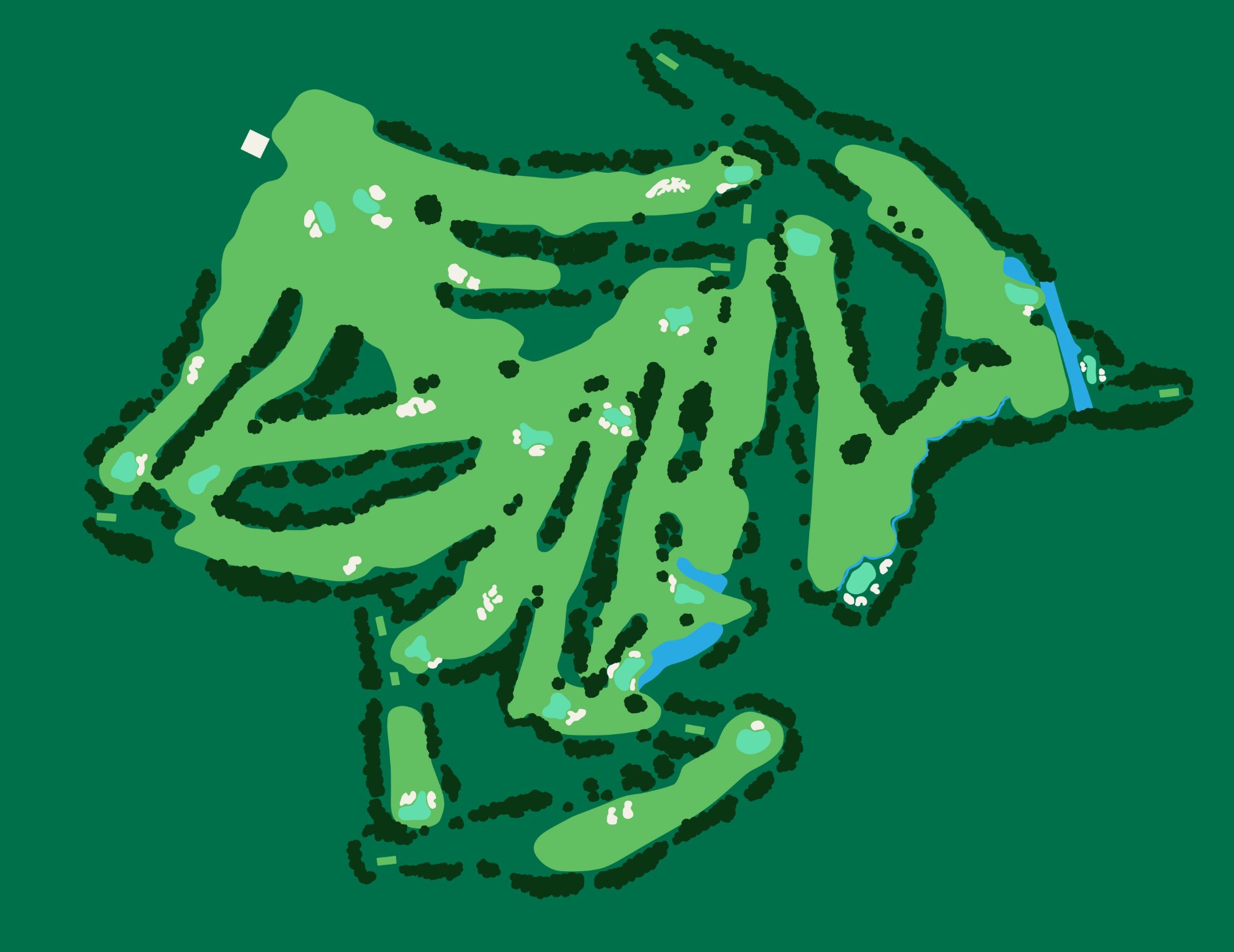
Augusta National
Ever since it opened, Augusta National has been in a constant state of evolution (for better or for worse), but it remains one of the greatest championship venues in the world
Hole 1 - Tea Olive
Augusta National's property is defined by a single broad downslope that ends at Rae’s Creek, and this par-4 opener is the only hole on the course that sits completely on top of it. Strategically, No. 1 at Augusta National is one of the most compelling opening holes in professional golf.
Hole 2 - Pink Dogwood
The second hole at Augusta National produces more off-the-tee variety than most par 5s in professional golf.
Hole 3 - Flowering Peach
Players face three basic options off the tee: hit a long iron or hybrid near the bunkers at the top of the first ridge, leaving a full wedge in; bash it left, past the bunkers and into the valley short left of the green; or go straight for the green in hopes of at least holding the narrow shelf short right. The most strategically complex hole on the golf course, “Flowering Peach” has stood the test of time, less affected by distance gains than most holes at Augusta National.
Hole 4 - Flowering Crab Apple
The first — and longest — par 3 at Augusta National has historically required a strong strike with at least a long iron, though club selections in the Masters have shifted as distance gains have spiraled out of control. Can you execute a towering shot with a long iron, hybrid, or fairway wood?
Hole 5 - Magnolia
“Magnolia” is like Paul Thomas Anderson’s film of the same name: brilliant, probably underrated, but a tad bloated. Nonetheless, the hole presents an honest challenge, and the green is one of the most artfully shaped at Augusta National (or anywhere else).
Hole 6 - Juniper
“Juniper” is, in our opinion, Augusta National’s second-best par 3. Each pin position presents a different range of challenges and exciting possible outcomes.
Hole 7 - Pampas
Yes, the green contours are fun, but “Pampas” has morphed into something that Alister MacKenzie likely would not endorse: a hole that merely defends itself through length and narrowness rather than asking complex strategic questions.
Hole 8 - Yellow Jasmine
This uphill three-shotter consistently produces the highest scoring average of Augusta National’s four par 5s, but it still presents a welcome birdie opportunity after the tough stretch of Nos. 4-7. “Yellow Jasmine” is the most underrated hole at Augusta National.
Hole 9 - Carolina Cherry
The ninth hole plays from a high point near the first and eighth greens, down through a valley frequently used by galleries, and up the hill where the clubhouse sits. From a risk-reward perspective, “Carolina Cherry” is a bit of a muddle.
Hole 10 - Camellia
The 10th hole kicks off the back half of the round in hair-raising fashion, plunging 100 feet into a valley shrouded by tall pines. Perry Maxwell’s 1938 transformation of “Camellia” is one of the rare cases in which a change to MacKenzie and Jones’s design represented a substantial improvement.
Hole 11 - White Dogwood
No. 11 is simply a brute, often playing as the most difficult hole to par at Augusta National. It’s also been one of the most frequently tinkered-with holes at Augusta National.
Hole 12 - Golden Bell
The focal point of Amen Corner and the center of gravity in any final round of the Masters, the 12th hole at Augusta National is as terrifying as it is beautiful.
Hole 13 - Azalea
This iconic risk-reward par 5 offers the first of a series of birdie opportunities on Augusta National’s home stretch.
Hole 14 - Chinese Fir
Although some nuances of MacKenzie and Jones’s original strategic concept for the hole have been lost, “Chinese Fir” is still a compelling par 4, rewarding precise and well-shaped shots both off the tee and into the green.
Hole 15 - Firethorn
No. 15 consistently presents one of the toughest decisions players have to make during their rounds: go for the green in two or lay up to one of the most demanding wedge shots in golf.
Hole 16 - Redbud
Set at the base of the ridge that the fifth green and sixth tee occupy, the par-3 16th hole provides a ready stage for championship-defining shots. Over the past several decades, the 16th has shown an undeniable knack for spectacle.
Hole 17 - Nandina
From tee to green, No. 17 is one of the simplest holes at Augusta National and is likely the least-loved hole on the second nine.
Hole 18 - Holly
“Holly” is a little funky, but its design is smart and elegant: bend it around the trees on the right and bypass some of the natural difficulty of the next shot.
Why Are They Such a Big Deal?
Mudballs add a level of variance that is nearly impossible to predict. The mud covers dimples, adds weight to one side or half of the ball, and can greatly impact solid, center-face contact when a course has taken on a significant amount of rain, like we’ve seen at Quail Hollow this week. Golf balls and equipment are carefully designed to perform their best under very specific, repeatable conditions. When something throws those conditions off, things can go awry. These players obsess over every minute detail, so when something like a mudball takes away predictability and alevel of comfort, they’re unhappy.
{{related-articles}}
“You spend your whole life trying to learn how to control a golf ball, and due to a rules decision all of a sudden you have absolutely no control over where that golf ball goes,” said world No. 1 Scottie Scheffler.
Typically, the PGA Tour is quick to implement the preferred lies ruling, which allows a player to lift, clean, and place their ball as long as it’s in the fairway. But, with hopes of upholding the “integrity” of their major, the PGA of America decided against such a ruling for Thursday.
How Do You Play a Mudball?
Over the years, we’ve discovered some general rules that tend to apply. "Mud left, ball right," Trevor Immelman explained to Golf Digest. "Mud on top, ball goes lower."
“I don't know, maybe hit it a little bit lower off the tee, but then unfortunately the problem with hitting it low off the tee is the ball doesn't carry or roll anywhere, so then you sacrifice distance,” said Xander Schauffele. “It’s a bit of a crapshoot.”
It’s impossible for a player to figure out the weight of the mud on the ball, meaning some shots might go 40 yards offline, and some might go 10. Scheffler and Schauffele fell victim to these unknowns on No. 16 at Quail Hollow in Thursday’s first round, and both made double bogey after rinsing their approaches from the fairway.
“We were in the middle of the fairway, and I don’t know, we had to aim right of the grandstands probably,” Schauffele noted. “I’m not sure, I aimed right of the bunker and it whipped in the water and Scottie whipped it in the water, as well.”
More Mudballs to Come at Quail
The mudballs have already been a nuisance at Quail Hollow, and Schauffele thinks they’ll get even worse.
“They're going to get worse as the place dries up,” he explained. “They're going to get in that perfect cake zone to where it's kind of muddy underneath and then picking up mud on the way through.”
I’m not sure the PGA of America was hoping for mudballs (and whatever the “perfect cake zone” is) to be the main subject of conversation after round one, but, as has become the theme, weird things happen at the PGA Championship.




Leave a comment or start a discussion
Engage in our content with thousands of other Fried Egg Golf Club Members
Engage in our content with thousands of other Fried Egg Golf Members


Reviewing Rory McIlroy: The Masters Wait
.jpg)
2026 FEGC Summer Member-Guest Details
Q&A: Gene Wojciechowski on New Novel, 'All Carry'
Excerpt: All Carry, A Novel by Gene Wojciechowski

March FEGC Hangout: Travel, Essex County Club, and Merion Golf Club Talk with Jack and Amanda Davis

New FEGC Opportunity: Member Day at Brambles (April 30, 2026)
Get full access to exclusive benefits from Fried Egg Golf
- Member-only content
- Community discussions forums
- Member-only experiences and early access to events
Leave a comment or start a discussion
Lorem ipsum dolor sit amet, consectetur adipiscing elit. Suspendisse varius enim in eros elementum tristique. Duis cursus, mi quis viverra ornare, eros dolor interdum nulla, ut commodo diam libero vitae erat. Aenean faucibus nibh et justo cursus id rutrum lorem imperdiet. Nunc ut sem vitae risus tristique posuere. uis cursus, mi quis viverra ornare, eros dolor interdum nulla, ut commodo diam libero vitae erat. Aenean faucibus nibh et justo cursus id rutrum lorem imperdiet. Nunc ut sem vitae risus tristique posuere.