The Templates: Biarritz
A history and analysis of C.B. Macdonald's Biarritz template


History
In 1888, Willie Dunn Jr. designed the Biarritz Golf Club and the par-3 third hole which was dubbed “the chasm.” The chasm was adopted by C.B. Macdonald as a template hole and named “the biarritz.” Fellow architects were slow to grow fond of the bold and controversial putting surface that Macdonald was employing and called it “Macdonald’s Folly” in the early years.
Characteristics
Biarritz holes are long par 3s, typically 210-240 yards, designed to test a player’s ability to hit accurate long shots. Its defining characteristic is the massive green that stretches up to 80 yards. The large green is bisected by a deep swale in the middle — usually 3-5 feet deep — and is protected by narrow bunkers on both sides of the green. As you will see below, some Biarritz holes feature front section of fairway rather than green, as the best pin positions are on the back portion behind by the deep swale. While Macdonald and Seth Raynor limited the Biarritz green to par 3s, modern architects have begun to use the it on par 4s and 5s, making the swale large enough to accommodate a pin position in the middle.
Strategy
The Biarritz is a fantastic design as it tests the skill and accuracy of a player’s longer clubs. Originally the hole required a driver, but with technology advancements it became a great long-iron test. The design presents a bevy of shot options and a variety of yardages. Due to their immense size, a Biarritz’s distance can differ by 60-70 yards on a given day, changing it from a birdie opportunity to a tough par. The green allows a player to hit any type of shot as a low running shot and a high shot are both equally effective. It is extremely important to hit your shot to the correct level as putting through the swale is difficult.
Piping Rock – Ninth hole – 227 yards
C.B. Macdonald’s first implementation of the Biarritz template came at the Piping Rock Club in Locust Valley, New York. The final hole of the front nine at Piping Rock is a Biarritz design that features a front section kept as fairway. A couple of unique aspects of Piping Rock’s biarritz are its front bunker and the way the back portion’s rough juts in on the left side.


Chicago Golf Club – Third hole – 256 yards
The long third plays slightly downhill into the corner of the property to a large and perfectly symmetrical green complex. Six sunken bunkers guard all sides of this hole, and a three-foot swale divides the short-grass approach from the putting surface. Like the original at Piping Rock, two rail-like ridges occupy the front platform that can guide low-flying shots towards the center of the green. While the putting surface appears flat, it tilts moderately from back to front and has a few subtle internal contours that make reading putts difficult.
{{chicago-golf-club-biarritz-3-gallery}}
Shoreacres – Sixth hole, par 3, 214 yards
Along some of Shoreacres’ least interesting terrain, Raynor placed this audacious Biarritz. From the back tee, the sixth hole – which features a 60-yard-plus long green – can play anywhere from 170 to over 230 yards. As with most full green biarritz holes, you feel like you missed out when the hole location is in the front half of the green.
{{shoreacres-biarritz-6-gallery}}
Camargo Club – Eighth hole – 227 yards
The Biarritz eighth regularly clocks in as one of the four most difficult holes on the course during Camargo’s annual U.S. Amateur qualifier. The eighth’s front plateau features a fairway slope which makes the front half unpinnable. The green is smaller than most, only 32 yards deep and 26 yards wide. The trench bunkers on the right and left side are particularly deep. These bunkers start at the fairway portion and run through the back edge.


The Yale Golf Course – Ninth – 213 yards
The Yale Golf Course — and its signature ninth hole Biarritz— is often considered Seth Raynor’s crowning achievement. The first challenge of the ninth is the 200-plus yard forced carry over water, and the real fun begins once the ball reaches the green. The hole features one of the deepest swales of any Biarritz and has a severe front-to-back and right-to-left slope in the back portion of the massive green.
We asked former Yale golfer Andrew Vitt to describe the ninth:
“Iconic. Two par 3s in one. Either long-iron to the back over an eight-foot swale or mid-iron to front over the water. When played in firm conditions, the front pin on No. 9 is total risk reward…land on very front or fringe to run a shot up bringing water into play, or land further on and risk getting gobbled up by the swale from hell. “


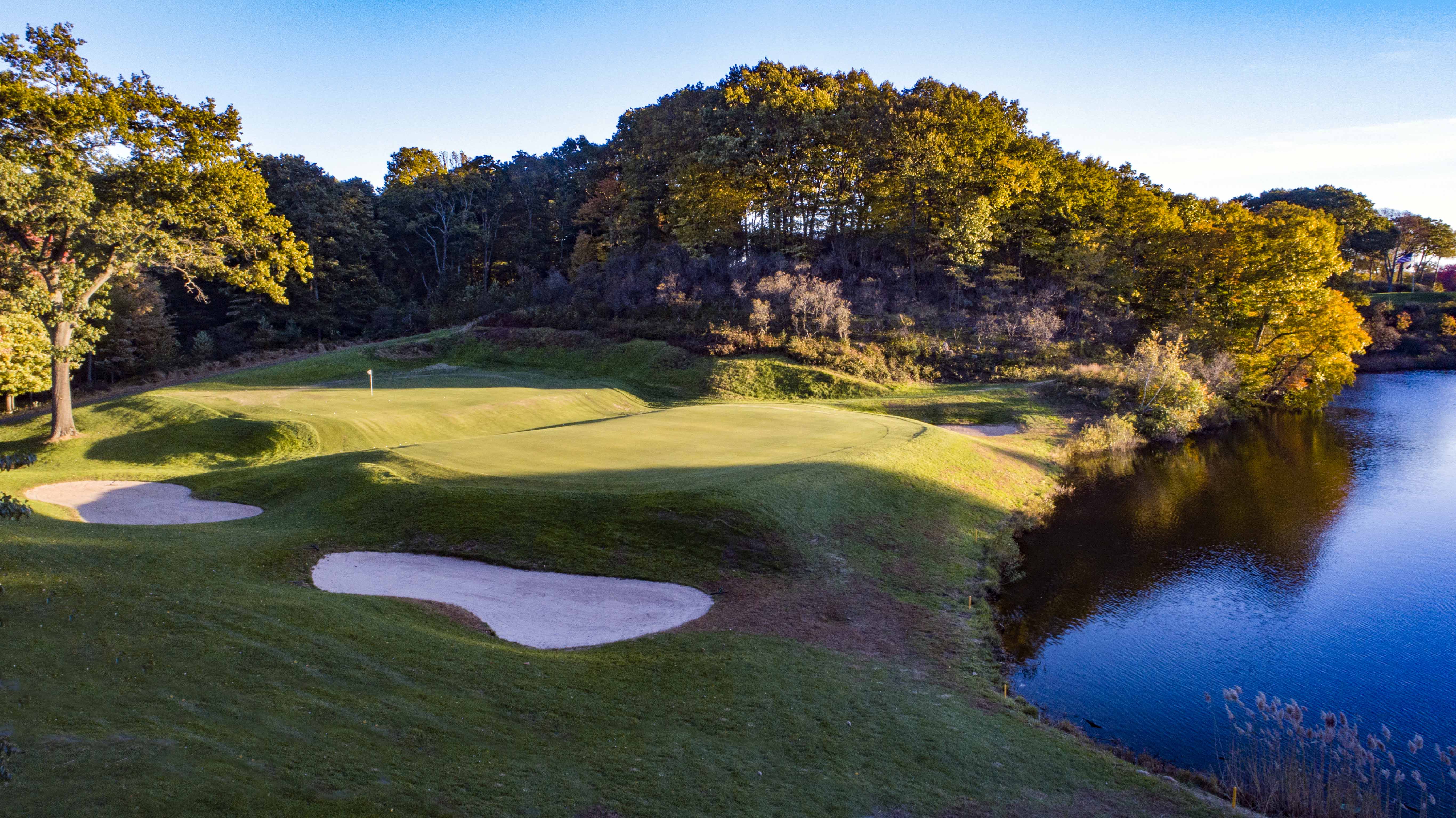
The Creek – 11th hole – 200 yards
The Creek’s is not the longest Biarritz hole, but it is definitely one of the most unique and intimidating. In Locust Valley, New York, Macdonald built the Biarritz hole in an inlet of the Long Island Sound. Stray shots pay the price of the water, whose level depends on the tide. Exposed to the Long Island Sound, the 11th at the Creek is as tough of a shot as you will find in golf, especially when the wind blows. The green is filled with micro contours and measures 86 yards from front to back.
{{content-block-biarritz-template-hole-001}}
Westhampton Country Club – 17th hole – 206 yards
Players looking to post a low score at Westhampton have to conquer the Biarritz 17th down the stretch. The predominant pin on the 17th is on the back tier which plays between 220-230 yards. This version of the Biarritz is more subtle than most Raynor designs. With modern technology this actually makes it easier to run a ball through the swale and play closer to the original intent of the hole.


Mountain Lake Golf Course – Fifth hole – 211 yards
At this Central Florida Raynor gem lies a nice little Biarritz. The green is roughly 50 yards long, allowing the hole to play from a mid-iron to a long-iron/hybrid. The hole has the signature trench bunkering on the left side but on the right, the brush tightens the hole and adds a unique difficulty.


Fox Chapel Golf Club – 17th hole – 231 yards
The 17th at Fox Chapel features an ever-so-slightly downhill tee shot to an 80-yard green. The surface itself is fairly subtle internally, relying instead on the natural grade which moves right-to-left and introduces an additional wrinkle when trying to run shots up the length of the green. The other element that players must contend with when attempting to get balls to the back portion of green is the extremely deep valley that bisects the putting surface – in this case, a nearly five-foot drop.
{{fox-chapel-biarritz-17-gallery}}
St. Louis Country Club – Second hole – 225 yards
Another tremendous Biarritz can be found at Macdonald’s SLCC. This design is treacherous for anyone who misses right. An extremely deep bunker guards the right side of the green, making for a near impossible up-and-down. The right hazard is dubbed “the bunker of death” because of how deep it is.


Fishers Island Club – Fifth hole – 229 yards
The secluded northeast gem features a terrific Biarritz. Fishers Island’s rendition features a fairway front portion that leads into the deep swale at the front edge of the green. Raynor showed no mercy when designing this hole, the long shot is particularly difficult when the wind kicks up at Fishers Island’s seaside location. The fifth at Fishers finishes off one of the most iconic three-hole stretches in the world.


Greenbrier (Old White) – Third hole – 205 yards
The only example of a Macdonald-designed Biarritz that is open to the public resides at the Greenbrier’s Old White course. This version is a little shorter than most but has all of the defining qualities: the long green, deep swale, and narrow bunkers on both the right and left side. One unique aspect of Old White’s Biarritz is that the middle swale is pinnable, as you see by the photo below.


Yeamans Hall – 16th hole – 225 yards
At Yeamans Hall, Raynor’s Biarritz 16th makes closing out a good round a difficult task. The front half this Biarritz is maintained as fairway and the deep swale makes this hole particularly challenging.


Southampton Golf Club – 14th hole – 197 yards
This 1925 Raynor design flies under the radar due to its high profile neighbors, National Golf Links of America and Shinnecock Hills. The 14th measures about 210 yards to back pins and about 170 yards to the front.


Blue Mound Golf & Country Club – Third hole – 220 yards
The Milwaukee-area Raynor design starts with a bang as the first three greens are a Redan, Double Plateau, and the difficult Biarritz third. The front half plays as fairway, making front pins just over the swale incredibly difficult. Like most Biarritz holes, the right and left sides of the green are flanked by deep trench bunkers.


Sleepy Hollow (Lower) – Seventh hole – 217 yards
Sleepy Hollow is Raynor’s gem on the Hudson River, and its seventh hole is a terrific Biarritz. This hole plays downhill with a front segment that kicks balls onto the back tier. It plays shorter because of its downhill nature, but when firm and fast the play from the tee is to land the ball short of the green. The back tier of the Biarritz has bunkers guarding each side.


North Shore Country Club – Fifth hole – 236 yards
The fifth hole is a lengthy 236 yards. The shot plays a little uphill with a fairway front tier and deep bunkers on both sides that penalize wayward shots. The green possesses two parallel ridge lines which create a subtle challenge. This is a common trick that Raynor used on many of his Biarritz greens.


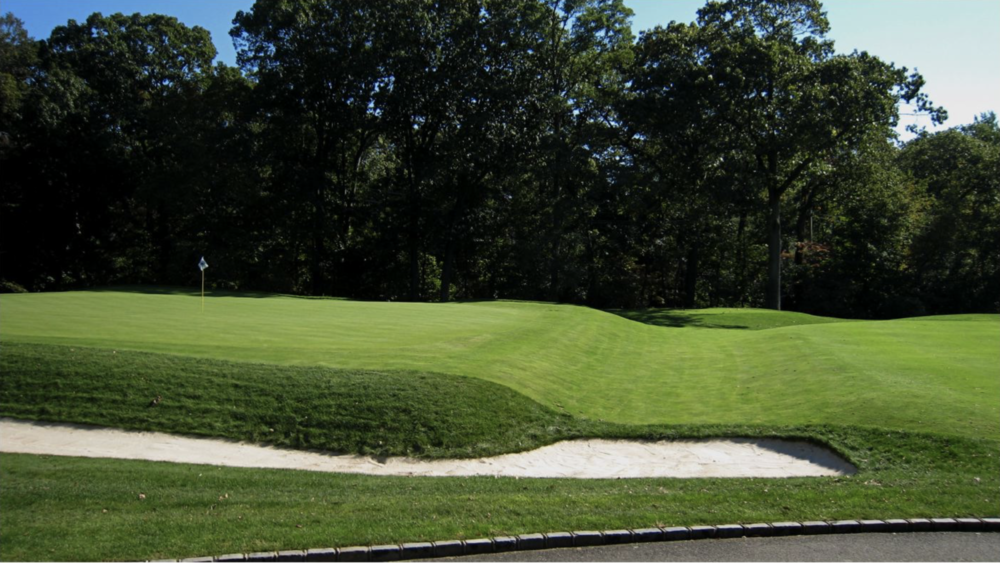
Elkridge Club – 13th hole – 245 yards
This Baltimore Raynor design has a brawny version of the Biarritz hole. Playing slightly downhill, the 13th is over 250 yards to a back pin, an ideal position to chase a ball in. The 13th has a unique green complex – in its front section, Raynor used a thumbprint, a trait he usually reserved for his Short holes. This contouring adds interest to the front pins which measure about 205 yards.


Forsgate Country Club – 17th hole – 235 yards
Banks’ masterpiece, Forsgate C.C., has a brute of a Biarritz hole. At 235 yards, it’s one of the longest renditions of the hole, but the real challenge comes at the green where Banks employed thumbprint undulations on both the front and back portions. The added undulation on the green make this one of the most difficult Biarritz holes in the world.


Whippoorwill Club – Eighth hole– 196 yards
Originally designed by Donald Ross, Whippoorwill hired Banks to give its club a facelift in the ’20s. Banks came in and employed template golf at this under the radar gem. The eighth is their Biarritz hole which plays downhill. This hole is particularly difficult when the pin location is in the back because of the steep back to front undulation that Banks built into the green.


Somerset Hills – 13th hole – par 4 – 409 yards
As a bonus, we include A.W. Tillinghast’s outstanding Somerset Hills, which is infused with template greens. At the 13th, Tillinghast chose to spice a straight away par 4 up by installing a Biarritz green. While Tilly didn’t quite build as deep of a swale as Raynor often did, you have to appreciate the subtlety and naturalness of Tillinghast’s 13th here.


Tamarack Country Club – 12th hole – par 3 – 223 yards
The 12th at Tamarack may be the most difficult example of the Biarritz. The putting surface is 70 yards long with an extremely deep swale in the middle, and the first two-thirds of the green slope with the terrain to the left. Penal bunkers also flank both sides of the green. As if all that wasn’t enough, a subtle thumbprint on the back tier adds even more difficulty to the iconic template.
{{tamarack-biarritz-12-gallery}}
Mid Ocean Club – 13th hole – par 3 – 238 yards
A downhill Biarritz, the par-3 13th at Mid Ocean Club is not maintained as originally designed. Macdonald initially had both the front and back sections of this hole mowed as green, but the club maintains just the back section these days to ensure the hole remains a long shot for all players. Even as is, the putting surface is massive, and a spine bisects the green into two halves. Missing in either greenside bunker leaves you with a long bunker shot.
{{mid-ocean-biarritz-13-gallery}}
Lookout Mountain – Fourth hole – par 3 – 224 yards
Although Raynor died before Lookout Mountain began construction, Charles Banks was able to carry out his wishes for the big and bold Biarritz fourth. The template is benched into the side of a hillside, so the back and right sides of the green pad had to be built up significantly, creating severe falloffs of 10-plus feet. This tilt also means you must start your tee ball farther left than you think to keep the ball on the surface.
{{lookout-mountain-4-biarritz-gallery}}


Leave a comment or start a discussion
Engage in our content with thousands of other Fried Egg Golf Club Members
Engage in our content with thousands of other Fried Egg Golf Members


Tree Removal in Golf Course Design
Reverse Camber in Golf Course Design

The Impact of Muirfield's Trademark Routing

School of Golf Architecture: Minimalism
The Ideal Holes of C.B. Macdonald

The Free Online Library of Golf Course Architecture
Get full access to exclusive benefits from Fried Egg Golf
- Member-only content
- Community discussions forums
- Member-only experiences and early access to events
Leave a comment or start a discussion
Lorem ipsum dolor sit amet, consectetur adipiscing elit. Suspendisse varius enim in eros elementum tristique. Duis cursus, mi quis viverra ornare, eros dolor interdum nulla, ut commodo diam libero vitae erat. Aenean faucibus nibh et justo cursus id rutrum lorem imperdiet. Nunc ut sem vitae risus tristique posuere. uis cursus, mi quis viverra ornare, eros dolor interdum nulla, ut commodo diam libero vitae erat. Aenean faucibus nibh et justo cursus id rutrum lorem imperdiet. Nunc ut sem vitae risus tristique posuere.