Shinnecock Hills Golf Club
A Golden Age architect’s magnum opus thanks to a sublime setting and stellar design, Shinnecock Hills is deep-rooted in American golf history

Southampton, New York, USA
Willie Davis (12 holes, 1891), Willie Dunn (18-hole expansion, 1894), C.B. Macdonald and Seth Raynor (redesign, 1901), William Flynn (redesign, 1931)
Private
The Architecture of Shinnecock Hills


2026 Fried Egg Golf U.S. Open Pool

Great Courses: Shinnecock Hills

Editor's Note: This course profile is usually reserved for Fried Egg Golf Club members but has been made public for U.S. Open week. Learn more about FEGC here.
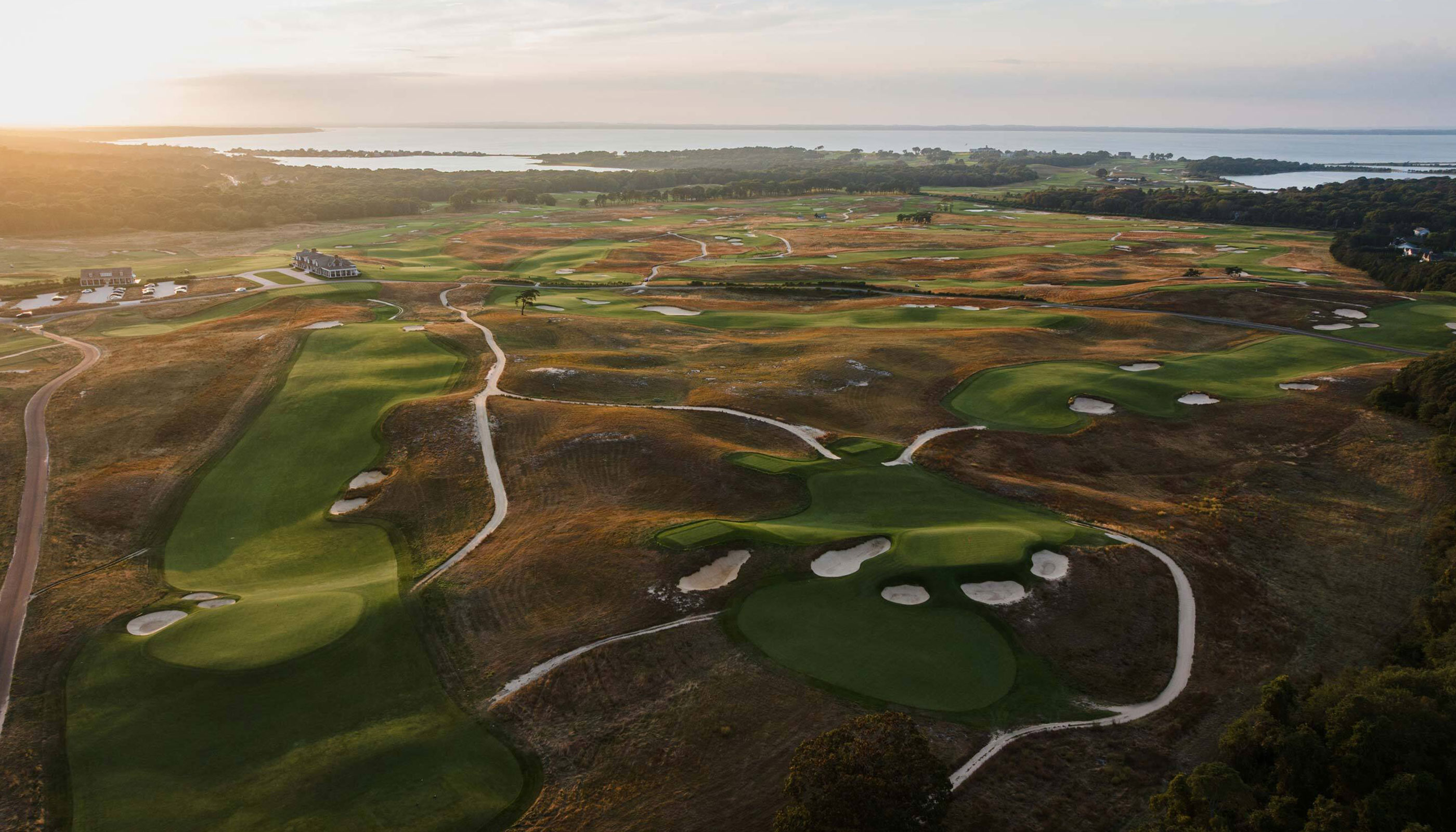
One of the country’s premier championship tests is also rooted in deep history as one of the USGA’s founding five members. Shinnecock Hills Golf Club stands as one of the finest golf courses in the world thanks to its sublime setting in Southampton and stellar William Flynn design. Shinnecock’s rumpled, sandy land that sits high on a ridge above the Peconic Bay presents a course that is overrun with natural advantages. An ever-present wind, firm turf, and outstanding land allowed William Flynn to create a punishing golf course, one where sound second shots and restraint are rewarded.
The club was founded in 1891 by a group of wealthy New Yorkers. The original Willie Davis course was 12 holes and the iconic Stanford White clubhouse was constructed a year later in 1892. It’s believed to be the first purpose-built clubhouse in America and remains today as an iconic landmark in the world of golf. The course underwent a great deal of change through the years, first at the hands of Willie Dunn, who expanded the golf course to 18 holes in 1894.
Following the construction of its neighbor, National Golf Links of America, Shinnecock felt the need to modernize its course. They hired a familiar pair, C.B. Macdonald and Seth Raynor, who together built the National a few years earlier. Macdonald, a member of Shinnecock, brought his ideal holes to Shinnecock, and the Macdonald/Raynor golf course stood until Route 27 was planned to cut through a number of the holes. The club purchased an additional parcel of land and brought in William Flynn to do a complete redesign of the course. Just two of the Macdonald/Raynor holes remain today, Nos. 3 and 7 in the northwest corner of the property.
.jpg)
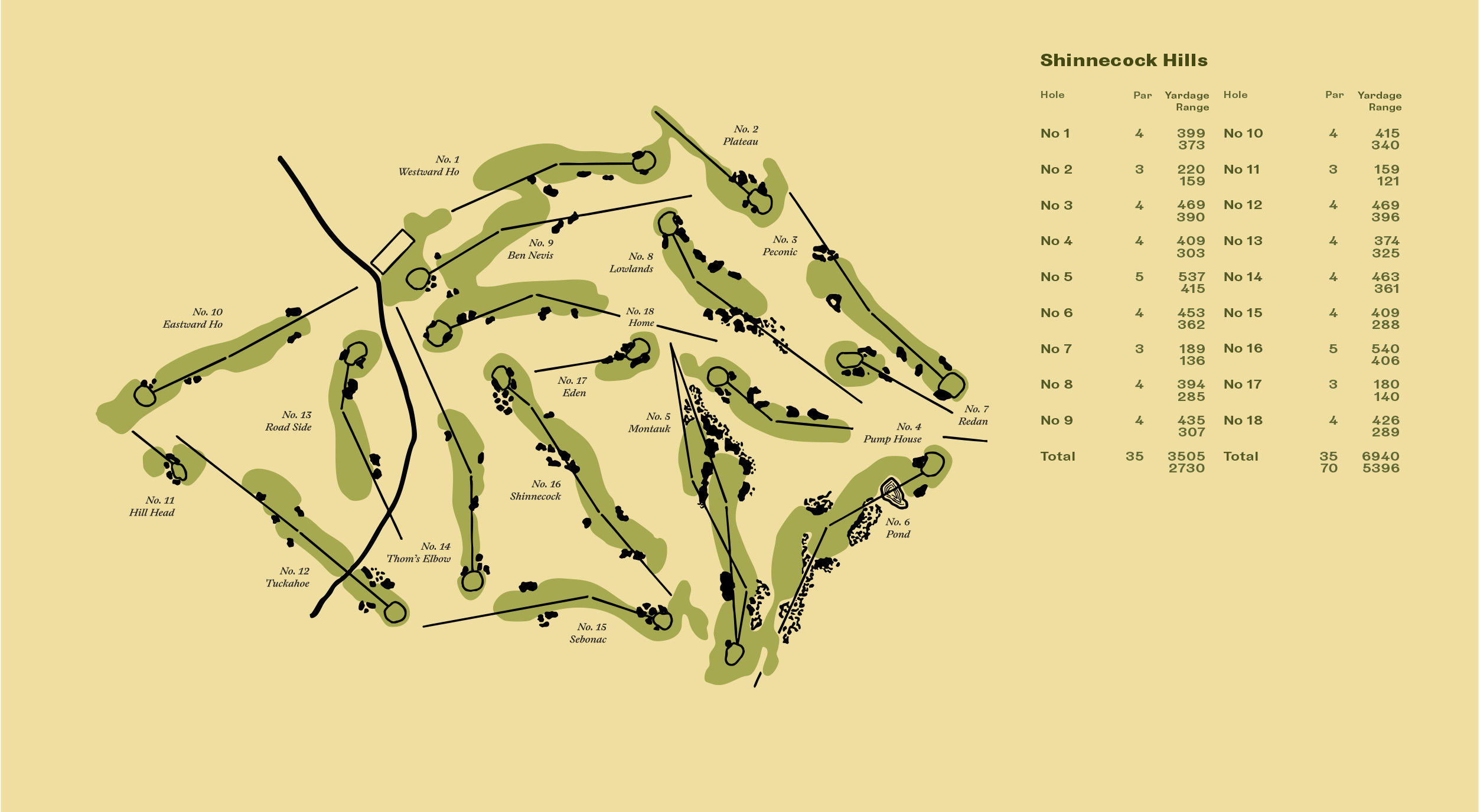
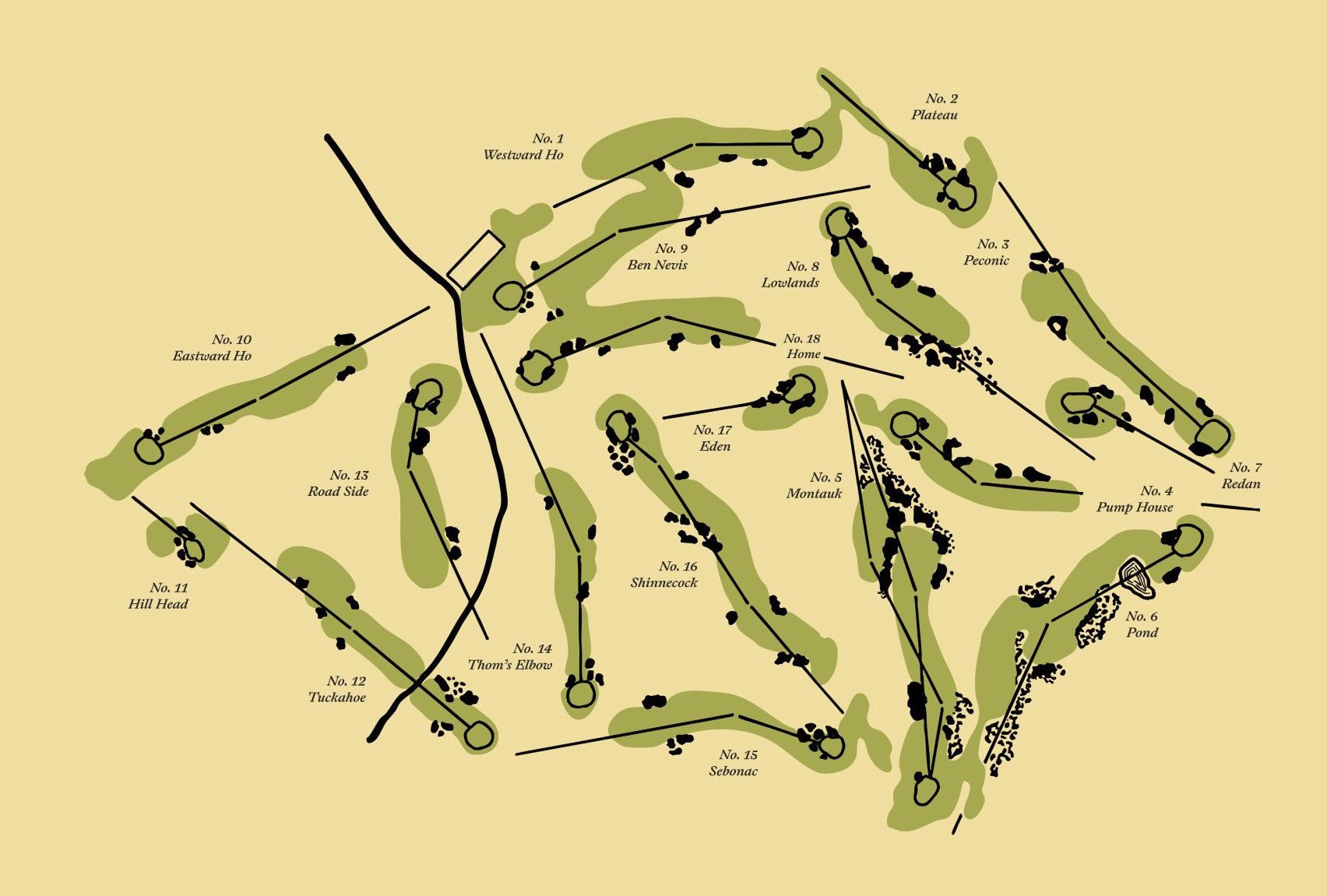
Flynn was a wonderful hire by Shinnecock Hills. At that point in his career, he had a lengthy resume of building golf courses that thrived on using natural topography. Flynn’s layout used the land to create groups of holes that moved in triangles to maximize the impact of the changing winds in Southampton. A master at getting the most out of a property, Shinnecock Hills is Flynn’s magnum opus.
In 2026, Shinnecock will add to its rich championship history and host its sixth U.S. Open.
Take Note...
Women’s golf. Shinnecock Hills was one of the few clubs that accepted female members in the early days. Beyond members, they also hosted the sixth-ever U.S. Women’s Amateur in 1900. The club’s largely open green fronts make it playable and friendly for lower-trajectory players.
First design. Shinnecock’s founders became interested in golf on a trip to France. Upon returning to North America, they thought that the only golf being played was at Royal Montreal Golf Club in Canada, so they commissioned RMGC head pro Willie Davis to design their course.
Nice reciprocal. In 1912, neighboring National Golf Links of America and Shinnecock Hills had a reciprocity agreement so members could play each other's club for $1. Adjusted for inflation, that’s $33.64 in 2026.
Founding Five. Shinnecock Hills is one of the USGA’s Founding Five clubs, along with Chicago Golf Club, Newport Country Club, The Country Club (Brookline) and St. Andrews.
{{shinnecock-hills-about-gallery}}
Favorite Hole
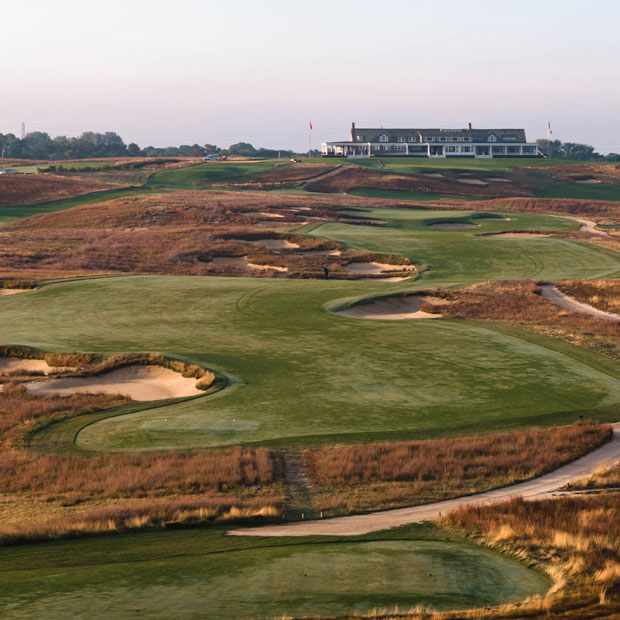
No. 6, par 4, 453 yards
This long par 4 is on some of Shinnecock’s most subdued land. The semi-blind tee shot offers a choice: take on the blindness over the sandy wash and be rewarded with an ideal, unobstructed approach to the green, or play safe to where you can see up the left side. The safe route is fraught with delayed challenges; the simple tee shot yields a significantly more difficult mid-iron approach into the well-protected green. The approach has to deal with the left greenside bunker as well as the falloff slope on the right side of the green. An approach from the right meanwhile yields an open front to run up a shot into the green. A wonderful hole thanks to its angles and perfectly placed features.
Favorite Hole
No. 6, par 4, 453 yards
This long par 4 is on some of Shinnecock’s most subdued land. The semi-blind tee shot offers a choice: take on the blindness over the sandy wash and be rewarded with an ideal, unobstructed approach to the green, or play safe to where you can see up the left side. The safe route is fraught with delayed challenges; the simple tee shot yields a significantly more difficult mid-iron approach into the well-protected green. The approach has to deal with the left greenside bunker as well as the falloff slope on the right side of the green. An approach from the right meanwhile yields an open front to run up a shot into the green. A wonderful hole thanks to its angles and perfectly placed features.
{{shinnecock-hills-favorite-hole-6-gallery}}
Overall Thoughts
Few championship courses have aged as gracefully as Shinnecock Hills. Advances in golf technology and athleticism have rendered many of its former peers obsolete and shells of their original selves. Thanks to some of its core ingredients of greatness, Shinnecock Hills has stood up to these advances, and in some ways become more distinguished in the modern era.
What makes Shinny great are its natural features. Few, if any, golf courses in the United States possess the trifecta of sublime terrain, sandy soils that allow for firm conditions, and an ever-present wind. As the sport has shifted further from art to science, these natural challenges create unique situations that require players to execute high-level, artistic shots.
While Shinnecock is widely considered one of the greatest courses in the world, its architect somehow still flies under the radar. William Flynn was at the height of his powers when he came to Shinnecock to redesign its C.B. Macdonald layout in 1927. A member of the Philly School of Architecture, a group of individuals who together helped transform and create the practice of golf course architecture in America, Flynn’s fame pales in comparison to more illustrious members, such as A.W. Tillinghast and George Thomas. A quick glance at his robust design portfolio — The Country Club (Ohio), Cherry Hills, and Huntingdon Valley, among others — makes you wonder why.
William Flynn’s nickname was “The Nature Faker” due to his penchant for creating lay-of-the-land golf designs on striking sites. At Shinnecock, Flynn was able to pair his beliefs of golf design with a site perfectly scaled for his particular style. His desire to use the topography as the chief design feature allowed the terrain to star, delivering both a mind-bending and physical test of golf. It was a match made in golf heaven.
The mecca of golf in America is the Eastern end of Long Island, where there are deep sand deposits and significant elevation changes. Shinnecock Hills Superintendent Jon Jennings described the geologic attributes as “glacial outwash.” Shinnecock may reside in the best pocket of golf in all of America, with neighboring properties National Golf Links of America, Sebonack, and Southampton all situated on stunning natural sites. Of the four courses, Shinnecock sits on the highest ground, with its magnificent Stanford White clubhouse perched above the course. The elevation provides important advantages as it accentuates the wind and also leads to drier playing conditions.
Flynn’s clever layout uses the high ridge and the clubhouse as a home point, and the course tumbles down to a lower and more subtle area on two separate occasions. The front nine spends all but the tee shot on No. 1 and the ninth green on the lower land. The back nine runs along the high ridge for Nos. 10-13 before the 14th hole plunges back down for the dramatic closing climb back up to the clubhouse. The variety of landforms on the property is one of its big differentiators from other sandy sites, and Flynn’s routing does a marvelous job of changing directions. On only a few occasions do two holes at Shinnecock run in a similar direction to each other. With the exposed, windy site, the constant shifts in direction keep players from getting accustomed to the wind, its strength, and how it impacts shots. The lower section of the course, where topographical features are slightly more muted, relies on some of Shinnecock’s most menacing green complexes and bunkers. Up high on the ridge, the holes that kick off the back nine lean on the spectacular topography. These holes all fit together seamlessly and deliver a round with some of the highest highs and very few lows.
Shinnecock Hills also represents the evolution of golf architecture in America. As one of the founding clubs of the USGA, the course encompassed the early aspects of golf in the States. It started in 1891 with Willie Davis’ rudimentary 12-hole design, and then came the Victorian era of Willie Dunn’s redesign in 1894. Then Macdonald and Seth Raynor applied the early principles of Golden Age architecture to the property in 1901. Finally, after additional property was purchased, Flynn was brought in, and his 1931 design showcases arguably the best era of design in American golf history: the late Golden Age. It’s sophisticated and understated, unlike Macdonald’s style, which can be seen next door at NGLA. Flynn embraced the land and its natural surroundings to produce arguably the greatest course in the world.
3 Eggs
I will listen to any argument that this is the greatest golf course in the world. For me, that list is about 10 courses long. Shinnecock Hills is exceptional and a cathedral of the sport. If you don’t feel like you will ever get a chance to play it, going to a championship like the upcoming U.S. Open or U.S. Women’s Open is worth your time.
Additional Content
Shinnecock Hills Golf Club
A Golden Age architect’s magnum opus thanks to a sublime setting and stellar design, Shinnecock Hills is deep-rooted in American golf history.
Hole 1 - Westward Ho
Hole 2 - Plateau
Hole 3 - Peconic
Hole 4 - Pump House
Hole 5 - Montauk
Hole 6 - Pond
Hole 7 - Redan
Hole 8 - Lowlands
Hole 9 - Ben Nevis
Hole 10 - Eastward Ho
Hole 11 - Hill Head
Hole 12 - Tuckahoe
Hole 13 - Road Slide
Hole 14 - Thom's Elbow
Hole 15 - Sebonac
Hole 16 - Shinnecock
Hole 17 - Eden
Hole 18 - Home

Hole 1

Hole 2

Hole 3

Hole 4

Hole 5

Hole 6

Hole 7

Hole 8

Hole 9

Hole 10

Hole 11

Hole 12

Hole 13

Hole 14

Hole 15

Hole 16

Hole 17

Hole 18
Leave a comment or start a discussion

Explore Related Content
Westhampton Country Club

Fishers Island Club
The Country Club (Pepper Pike)
Mountain Lake

Philadelphia Country Club
Lookout Mountain Golf Club
2026 Fried Egg Golf U.S. Open Pool

Every Hole at Shinnecock Hills: History, U.S. Open Strategy, and More

The Era of the Sensible U.S. Open Setup

The skinny on Shinny: Part II – The restoration

The skinny on Shinny: Part I – The class
Get full access to exclusive benefits from Fried Egg Golf
- Member-only content
- Community discussions forums
- Member-only experiences and early access to events

Leave a comment or start a discussion
Lorem ipsum dolor sit amet, consectetur adipiscing elit. Suspendisse varius enim in eros elementum tristique. Duis cursus, mi quis viverra ornare, eros dolor interdum nulla, ut commodo diam libero vitae erat. Aenean faucibus nibh et justo cursus id rutrum lorem imperdiet. Nunc ut sem vitae risus tristique posuere. uis cursus, mi quis viverra ornare, eros dolor interdum nulla, ut commodo diam libero vitae erat. Aenean faucibus nibh et justo cursus id rutrum lorem imperdiet. Nunc ut sem vitae risus tristique posuere.