
On the Skillet: No. 2 at Bel-Air
One way to make a carry hazard fun


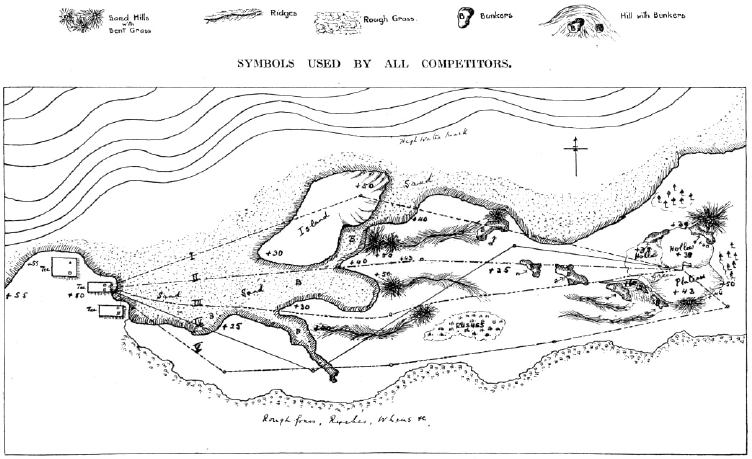
George Thomas was obsessed with designing golf holes that provided different pathways for different kinds of players. In the hole diagrams Thomas included in his book Golf Architecture in America, there were almost always separate lines for stronger and weaker players. Many of these concepts were so eccentric that, like Alister MacKenzie’s Lido-contest winner, they were impractical to build. At his actual courses, Thomas often found subtler ways of leveling the playing field between long and short hitters.
Take, for instance, the second hole at Bel-Air Country Club. This 440-yard par 4 travels uphill to a green set into a ridge. An enormous baseball glove of a bunker guards the front of the green but leaves a narrow opening on the right. The best position to hit your approach from is the right-center section of the fairway.

There’s a catch, though: Thomas placed another large bunker in exactly that spot.

Power players would normally have an outsize advantage on this type of long par 4. Being able to carry the fairway bunker not only shortens the hole but also garners a better angle. On the No. 2 at Bel-Air, however, Thomas created a route for a shorter-hitting player. Short and left of the fairway bunker, there is a left-to-right kicker slope. If you hit a low-trajectory tee shot over the shoulder, your ball will catch the slope and roll around the bunker. In other words, you don’t have to make the raw carry; you can use smarts and precision to find the advantageous position.

Tom Doak, who completed a restoration project at Bel-Air in 2018, sees this hole as proof of Thomas’s ability to design compelling golf on relatively plain land. “I’m fond of [the hole] because it’s maybe not the most dramatic part of the ground, and as an architect I wouldn’t have known what I was going to do there when I started,” Doak told us during an interview for our George Thomas documentary, “[but Thomas] came up with something really good and really interesting.”
While the second hole at Bel-Air may not as flashy as the five-fairway spectacle on p. 152 of Golf Architecture of America, its well-placed bunkers and savvy use of the topography make it memorable and fun to play for a variety of golfers.



Reimagining Golf As College Football Conferences

An Ode to Odd Sets of Clubs

2027 Fried Egg & FEGC Event Lottery and Registration Process

Five Things: A Reinstated Amateur Solution, Kapalua Returns, and LPGA Players to Watch
September FEGC Virtual Hangout: Get to Know Meg Adkins
On Finding the Fun in Golf (Again)
Get full access to exclusive benefits from Fried Egg Golf
- Member-only content
- Community discussions forums
- Member-only experiences and early access to events